 80314388

Partial ACL Tear vs Complete ACL Tear: Do You Need Surgery?
Summary:
- A partial ACL tear may be managed without surgery, while a complete ACL tear more often requires ACL reconstruction surgery.
- The right knee ACL treatment in Singapore depends on the severity of the tear, your activity level, and your long-term goals.
- Early assessment by an orthopaedic specialist is key to preventing further damage to the knee.
You felt a pop in your knee, followed by swelling and instability. Now you are wondering whether you have a partial or complete ACL tear, and whether you need surgery.
It is a question worth getting right. The answer affects not just how your knee feels now, but how it holds up years down the line.
What is the ACL and how does it tear?
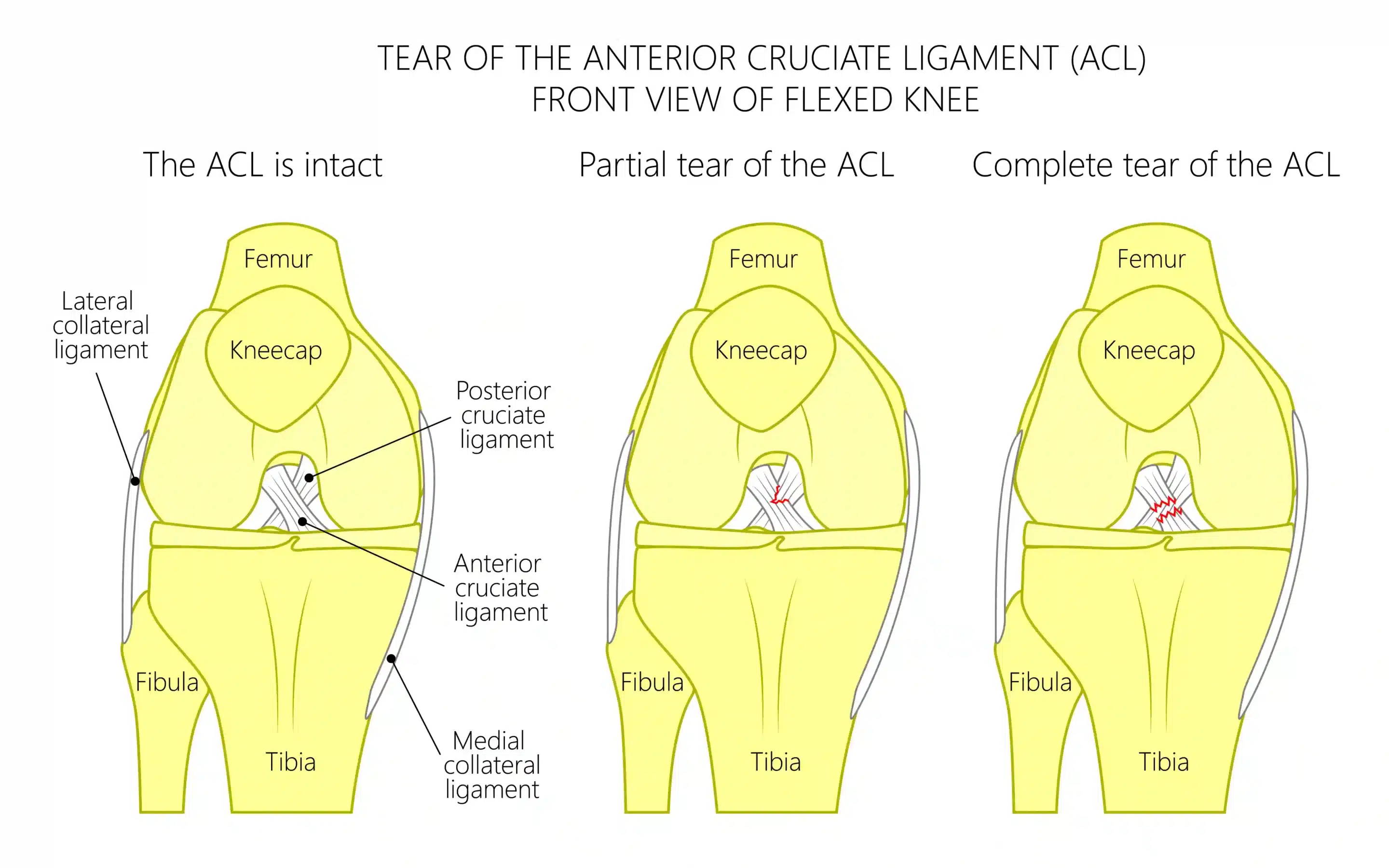
The anterior cruciate ligament (ACL) sits at the centre of your knee, controlling rotational movement and stopping the shin bone from sliding forward. It takes the brunt of sudden pivots, jumps, and direction changes, which is why ACL injuries are so common in sports.
Tears fall into two broad categories. A partial ACL tear means only some of the ligament fibres are disrupted. The knee may still feel reasonably stable, though pain and swelling are common. A complete tear is a full rupture. The knee loses its primary stabiliser, and that instability tends to be hard to miss.
Partial ACL tear symptoms vs complete ACL tear symptoms
The two injuries can feel similar at first, but the differences become clearer over the following hours and days.
Partial ACL tear symptoms tend to be more measured: moderate pain around the joint, swelling that builds gradually over several hours, some stiffness, and a sense that the knee is not quite right during activity. You can usually still bear weight.
Complete ACL tear symptoms are harder to ignore. There is often a loud pop at the moment of injury, followed by rapid swelling within hours. The knee gives way during movement, and bearing weight can be difficult or impossible.
If you have had a knee injury and are not sure which you are dealing with, do not wait it out. Getting a proper assessment early prevents the kind of secondary damage to the meniscus and cartilage that comes from walking on an unstable joint.
At Spire Orthopaedic Centre, we provide emergency and acute care services for knee injuries. Contact us today.
How is an ACL tear diagnosed?
Your orthopaedic specialist will examine the knee physically, checking stability, range of motion, and where the pain is concentrated. From there, imaging confirms what the physical exam suggests.
An MRI is the most reliable tool for seeing the extent of the tear and identifying any associated injuries such as a meniscus tear. An X-ray is used to rule out bony involvement, including an ACL avulsion fracture, where the ligament pulls a fragment of bone away from its attachment point.
Do you need ACL surgery?
Not necessarily. The decision depends on several things: the severity of the tear, how stable the knee is, your age, your activity level, and what you want to get back to doing.
For some patients with a partial ACL tear and good residual stability, non-surgical knee ACL treatment is appropriate. This involves a period of protected rest, bracing for support, and a structured rehabilitation programme to rebuild strength around the joint. If the knee remains unstable despite this, surgery may still be the better option.
Complete ACL tear surgery is generally recommended for patients who are younger, active, or play sports that involve pivoting and jumping. An unstable knee does not just limit activity; it puts the meniscus and cartilage at ongoing risk with every step.
ACL reconstruction surgery in Singapore replaces the torn ligament with a graft, most commonly taken from the patient’s own hamstring tendon, patellar tendon, or quadriceps tendon. The procedure is performed arthroscopically through small incisions. Your surgeon will recommend the most suitable graft based on your anatomy, activity goals, and any prior knee injuries.
ACL recovery timeline
Recovery time varies depending on whether you have surgery or not.
For non-surgical management of a partial ACL tear, most patients are looking at three to six months before the knee feels stable and functional again. Post-surgery, the ACL recovery timeline is longer, typically six to nine months before returning to high-impact sports. Early recovery centres on reducing swelling and restoring range of motion, with strength work and sport-specific activity building progressively under specialist guidance.
Seek ACL treatment in Singapore early
An unstable knee left unmanaged does not stay the same; it tends to get worse. ACL fracture treatment in Singapore and an accurate diagnosis early on are what protect the knee from compounding damage over time.
At Spire Orthopaedic Centre, our orthopaedic specialists will assess your injury thoroughly, walk you through your surgical and non-surgical options, and work with you on the right treatment plan. Whether that means conservative management or ACL reconstruction surgery in Singapore, we will guide you through every stage.
Book a consultation today and get a clear picture of your knee injury.
Our Doctors

Dr. Chee Kin Ghee
Dr Chee is a hand surgeon in Singapore with over 20 years of experience in hand and orthopaedic surgery.
He is currently practising at Gleneagles Hospital and was a visiting consultant at Tan Tock Seng Hospital to train the residents towards their specialisation in hand surgery.

Dr. Ambrose Yung
Dr Ambrose Yung Wai Yin is an experienced Specialist Orthopaedic Consultant with 20 years of experience in the field of orthopaedics. His area of interest extends includes complex operations such as revision knee arthroplasty, partial knee replacement and primary total knee replacement.
View More
Dr. Low Mun Hon
Dr Low Mun Hon has over 20 years of experience managing trauma and orthopaedic clinical care.
Prior to this, he has been in private practice as a practitioner at Singapore Sports & Orthopaedic Clinic (SSOC).

Justin Lim Xuan Li Physiotherapist
Justin is a skilled and experienced physiotherapist who specializes in the treatment of neuro-musculoskeletal conditions - nerve, muscle and joint problems.
View More
Chan Jing Cheng (JC) Physiotherapist
JC has over 12 years of experience in treating Chronic pain, Orthopaedic and Geriatric conditions. He had worked at various Private Hospitals, Singapore General Hospital, NTUC Health Elder Care and Lions Home for the Elders.
View More
Joanna Lim Hand Occupational Therapy
Joanna obtained her Diploma in Occupational Therapy (Merit) from Nanyang Polytechnic in 2006. Under the MOH Health Science Scholarship, she graduated from La Trobe University, Australia, with a Bachelor’s degree in Occupational Therapy (1st class Honours) the following year. Upon graduation, she worked in Changi General Hospital and Sengkang General Hospital.
View MoreConsultation
Spire Orthopaedic Physiotherapy & Rehab Centre
Spire Orthopaedic Centre @ Royal Square
101 Irrawaddy Road, #18-03
Royal Square Medical Centre, Novena
Singapore 329565
Tel: (65) 6970 4468
Mobile: (65) 8031 4388
Email: admin@spireortho.com.sg
SPIRE HIP & KNEE CENTRE
Spire Orthopaedic Centre @ Gleneagles Medical Centre
6 Napier Road #08-04
Singapore 258499
Tel: (65) 6970 6628
Mobile: (65) 8317 7388
Email: gmc@spireortho.com.sg
SPIRE HAND CENTRE
Spire Hand Centre @ Mount Elizabeth Medical Centre
3 Mount Elizabeth #15-14
Singapore 228510
Mobile: (65) 9657 2268
Email: meoh@spireortho.com.sg