 80314388

Trigger Finger vs Dupuytren’s Contracture: What Is the Difference?
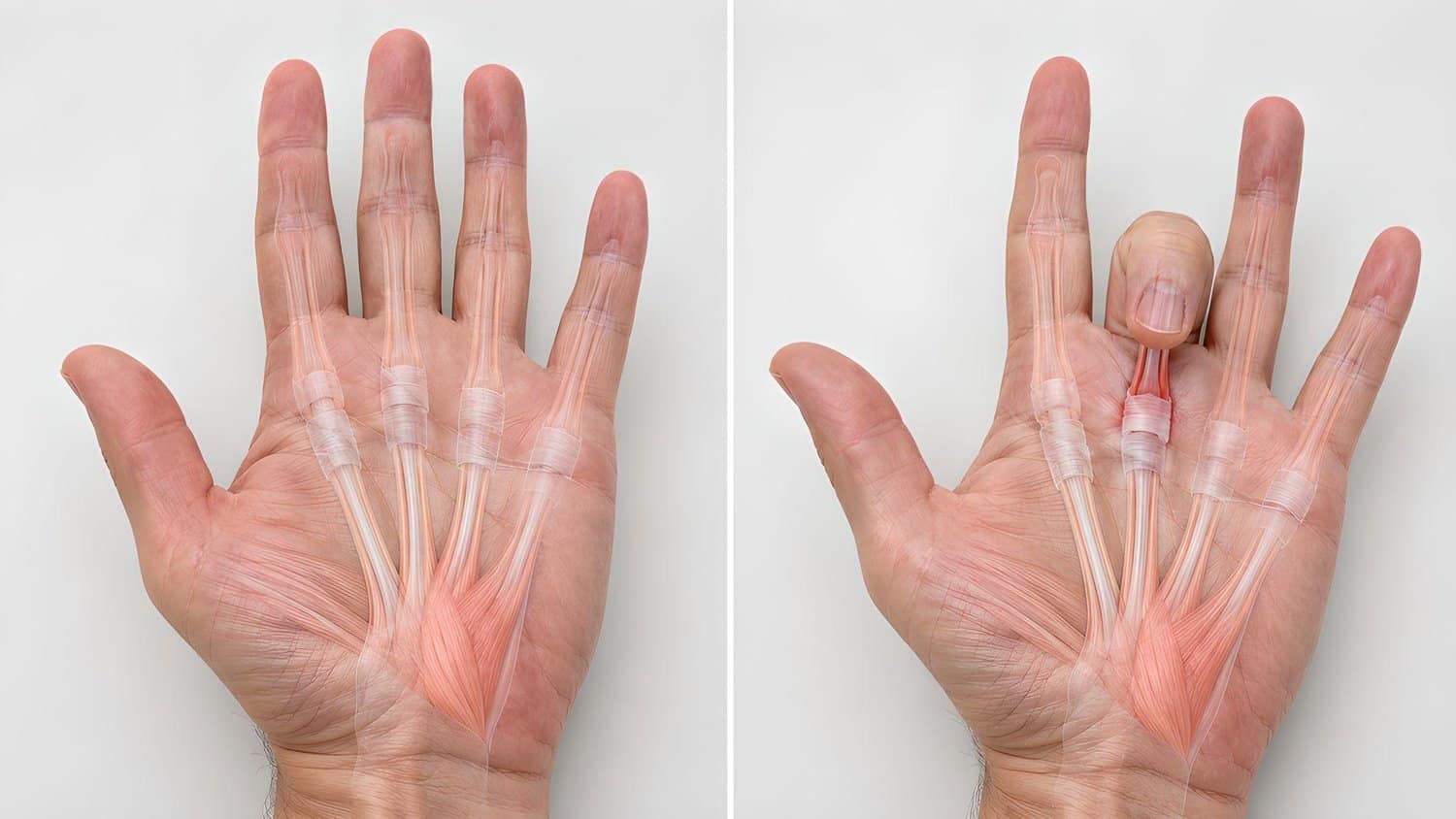
- Trigger finger and Dupuytren’s contracture are distinct hand conditions that both affect finger movement, but they have different causes, different presentations, and different treatment approaches.
- Trigger finger involves the tendon catching or locking as it passes through a narrowed sheath; Dupuytren’s contracture involves progressive thickening of the tissue beneath the palm that pulls the finger into a bent position.
- Early assessment by a hand specialist in Singapore gives you the clearest picture of what you are dealing with and the widest range of treatment options.
But they are not the same condition. They develop through different mechanisms, feel different to the patient, and require different treatment. Getting the right diagnosis matters, because treating one as if it were the other gets you nowhere.
What is a trigger finger?

Trigger finger (stenosing tenosynovitis) occurs when the tendon responsible for bending a finger becomes inflamed and swollen, making it difficult to glide smoothly through the tendon sheath. The result is a catching, clicking, or locking sensation when bending or straightening the finger.
In early stages, the catching is intermittent and often painless. As the condition progresses, the finger may lock fully in a bent position and require physical force to straighten. There is often a tender nodule at the base of the finger on the palm side.
Any finger can be affected, though the ring finger and thumb are most common. It occurs more frequently in women and in patients with diabetes, rheumatoid arthritis, or gout.
What is Dupuytren’s contracture?

Dupuytren’s contracture is a condition where the fascia, the layer of connective tissue beneath the skin of the palm, thickens and contracts over time, forming rope-like cords that pull one or more fingers into a permanently bent position.
Unlike trigger finger, there is no catching or locking. The finger does not release with effort. Instead, it progressively loses the ability to straighten at all, not because the tendon cannot move, but because the tissue underneath the skin is physically pulling it down.
It most commonly affects the ring finger and little finger. It is significantly more common in men, in those of Northern European descent, and in patients with diabetes or a family history of the condition. Alcohol use and certain medications have also been associated with higher rates.
How to tell them apart
The clearest distinction is this: trigger finger involves a tendon that catches and releases during movement, the finger still responds to effort, just unpredictably. Dupuytren’s contracture involves a fixed, progressive flexion deformity, the finger cannot be straightened passively or actively, regardless of effort.
A few other differences:
- Trigger finger typically involves pain, particularly at the base of the finger. Dupuytren’s is often painless, even in advanced stages.
- Trigger finger develops over weeks to months. Dupuytren’s typically progresses very slowly over years.
- In trigger finger, you can often feel a nodule at the A1 pulley at the base of the finger. In Dupuytren’s, you feel a cord running through the palm toward the affected finger.
- Trigger finger responds well to injection and, when needed, a straightforward surgical release. Dupuytren’s requires a different surgical approach, needle fasciotomy, collagenase injection, or fasciectomy depending on severity.
It is also possible to have both conditions simultaneously, as they share some of the same risk factors. This is another reason a proper clinical assessment is worth doing early.
Treatment options in Singapore
Trigger finger treatment in Singapore is staged based on severity. Mild cases may respond to splinting and a period of rest. A corticosteroid injection into the tendon sheath is effective for many patients. When symptoms persist or are severe, a trigger finger operation, a minor day procedure under local anaesthesia, releases the constricted sheath and restores normal tendon movement.
For Dupuytren’s contracture, the right treatment depends on how far the contracture has progressed. A tabletop test, whether you can place your hand flat on a table, is a useful guide. Options include:
- Needle fasciotomy: A minimally invasive procedure where the contracted cord is divided using a needle, often suitable for early-stage contractures
- Collagenase injection: An enzyme injection that breaks down the cord, allowing the finger to be straightened; suitable for selected cases
- Fasciectomy: Surgical removal of the affected fascia; recommended for more advanced contractures or recurrences
See a hand specialist in Singapore
If you are noticing any changes in finger movement, catching, locking, or a progressive inability to straighten a finger, an assessment by a hand specialist in Singapore will give you a clear diagnosis and the appropriate treatment plan.
At Spire Orthopaedic Centre, our hand specialists are experienced in diagnosing and treating both trigger finger and Dupuytren’s contracture, from early conservative management through to surgical correction where needed.
Book a consultation today before the condition progresses further.
Our Doctors

Dr. Chee Kin Ghee
Dr Chee is a hand surgeon in Singapore with over 20 years of experience in hand and orthopaedic surgery.
He is currently practising at Gleneagles Hospital and was a visiting consultant at Tan Tock Seng Hospital to train the residents towards their specialisation in hand surgery.

Dr. Ambrose Yung
Dr Ambrose Yung Wai Yin is an experienced Specialist Orthopaedic Consultant with 20 years of experience in the field of orthopaedics. His area of interest extends includes complex operations such as revision knee arthroplasty, partial knee replacement and primary total knee replacement.
View More
Dr. Low Mun Hon
Dr Low Mun Hon has over 20 years of experience managing trauma and orthopaedic clinical care.
Prior to this, he has been in private practice as a practitioner at Singapore Sports & Orthopaedic Clinic (SSOC).

Justin Lim Xuan Li Physiotherapist
Justin is a skilled and experienced physiotherapist who specializes in the treatment of neuro-musculoskeletal conditions - nerve, muscle and joint problems.
View More
Chan Jing Cheng (JC) Physiotherapist
JC has over 12 years of experience in treating Chronic pain, Orthopaedic and Geriatric conditions. He had worked at various Private Hospitals, Singapore General Hospital, NTUC Health Elder Care and Lions Home for the Elders.
View More
Joanna Lim Hand Occupational Therapy
Joanna obtained her Diploma in Occupational Therapy (Merit) from Nanyang Polytechnic in 2006. Under the MOH Health Science Scholarship, she graduated from La Trobe University, Australia, with a Bachelor’s degree in Occupational Therapy (1st class Honours) the following year. Upon graduation, she worked in Changi General Hospital and Sengkang General Hospital.
View More