 80314388

Lower Back Pain When Sitting for Long Hours: Causes, Treatment & Relief
Summary:
- Sitting for long hours places continuous pressure on your lower spine, which can lead to lower back pain and sciatica pain.
- Common causes include poor sitting posture, weak core muscles, tight hip flexors, and underlying disc-related issues.
- Sciatica treatment and lower back pain treatment in Singapore range from posture correction and medication to surgery where necessary.
Most people brush off lower back pain from sitting as a sign they need to move more. And while that is partly true, there is often more going on than simple muscle fatigue.
For many people in Singapore who spend long hours at a desk, the pain that builds through the day, and sometimes carries into the night, is the spine responding to sustained load it was not designed to handle. Here is what is actually happening, and what you can do about it.
Why sitting puts your lower back under strain
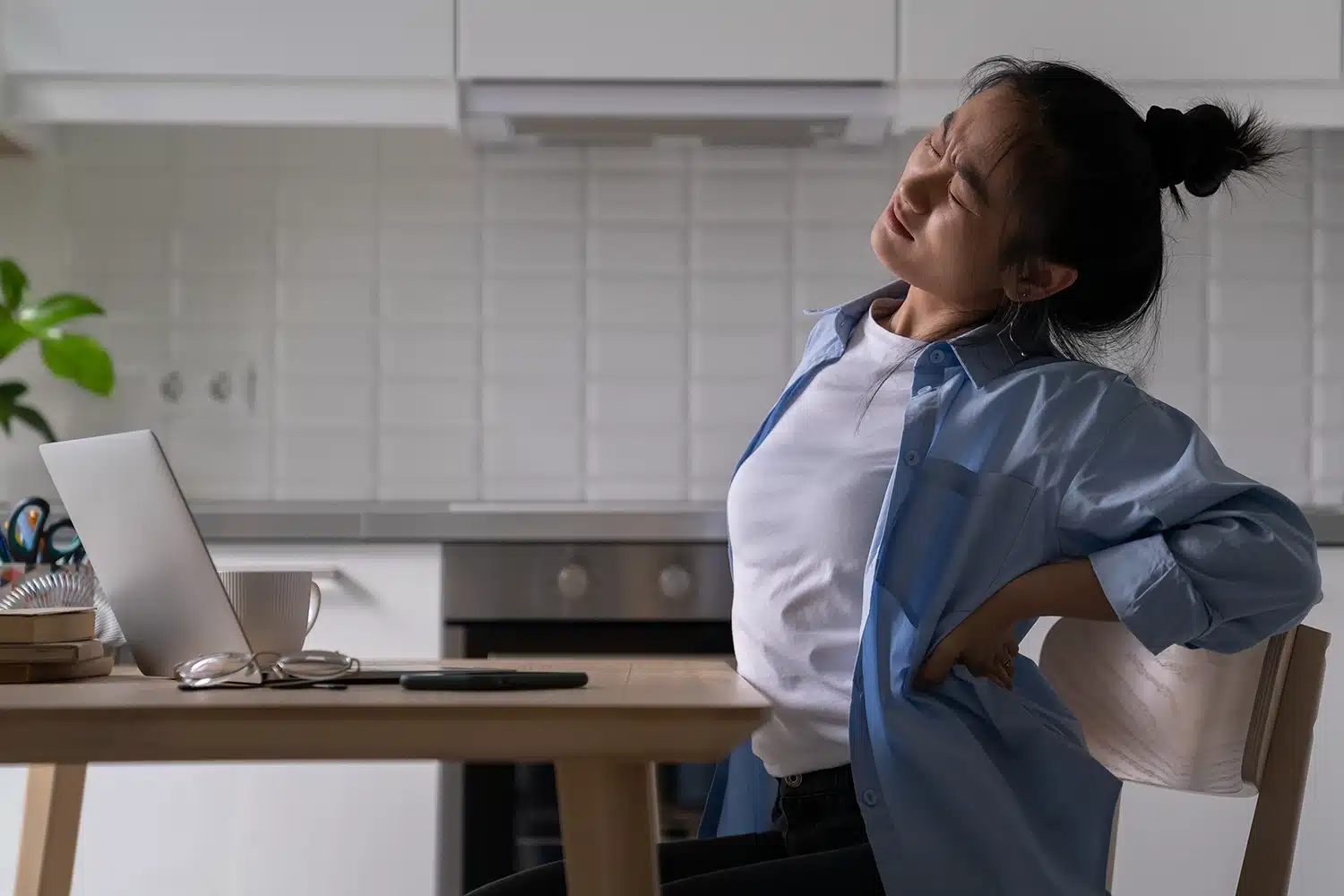
Your spine is built for movement, not stillness. When you sit for extended periods, the structures in your lower back, including discs, muscles, and ligaments, absorb compressive forces that accumulate over time. Poor sitting posture makes this worse.
A few specific reasons this happens:
Slouching over a screen rounds your lower back and shifts load onto the discs between your vertebrae, which wear down faster under sustained pressure. Sitting also keeps your hip flexors in a shortened position for hours, which tilts your pelvis forward and increases lumbar strain. And because your core and glutes are largely inactive when seated, your lower back ends up doing stabilising work it should not have to do alone.
None of this happens dramatically. It builds slowly, which is why lower back pain from sitting tends to creep up on people before they notice how bad it has got.
Could it be sciatica?

If the pain is not staying in your lower back but travelling down into your buttock, thigh, calf, or foot, that is worth paying attention to. It may be sciatica.
Sciatica pain happens when the sciatic nerve, which runs from your lower spine through each leg, gets irritated or compressed. Prolonged sitting, particularly in a slumped position, can worsen this compression over time.
Signs that the sciatic nerve may be involved:
- Shooting or burning pain down one leg
- Tingling or numbness in the buttock, thigh, or foot
- Pain that is noticeably worse after sitting for long periods
- Weakness or heaviness in the affected leg
Also read: Can Poor Posture Cause Sciatica Pain?
Sciatica treatment in Singapore
Sciatica treatment in Singapore starts with understanding what is causing the nerve irritation. The approach varies depending on severity, but conservative care almost always comes first.
Adjusting your sitting posture and workstation setup is often one of the first things your specialist will recommend. Your chair should support the natural curve of your lower back, your screen at eye level, feet flat on the floor. These adjustments reduce cumulative spinal load through the day.
For pain management, anti-inflammatory medication or heat and cold therapy can help during flare-ups. Your doctor will advise on dosage and duration.
When conservative sciatica pain treatment has not resolved symptoms and imaging confirms significant nerve compression, surgery becomes an option. The most common procedure is a microdiscectomy, a minimally invasive operation that removes the disc material pressing on the nerve. Most patients find meaningful relief following surgery, though this is always a decision made in consultation with your orthopaedic specialist.
Lower back pain treatment in Singapore
For lower back pain that is not sciatica-related, the same conservative-first approach applies. Treatment options include:
- Medication: Anti-inflammatory drugs or muscle relaxants for acute pain episodes
- Activity modification: Reducing prolonged sitting, taking regular movement breaks, pacing your daily routine
- Surgery: Reserved for cases where a structural issue, such as a disc pressing on a nerve, has not responded to other treatment
If you are looking for long sitting back pain relief and are not sure where to start, a proper orthopaedic assessment is the right first step. Guessing at the cause rarely leads anywhere useful.
When to see a specialist in Singapore
Lower back pain that has been going on for more than a few weeks, or that is getting worse rather than better, deserves a proper look. The same goes for any pain that is disrupting your sleep or limiting what you can do day to day.
At Spire Orthopaedic Centre, our specialists will assess your symptoms thoroughly, identify the cause, and put together a lower back pain treatment plan built around your condition and lifestyle.
Book a consultation today and take the first step towards lasting relief.
Our Doctors

Dr. Chee Kin Ghee
Dr Chee is a hand surgeon in Singapore with over 20 years of experience in hand and orthopaedic surgery.
He is currently practising at Gleneagles Hospital and was a visiting consultant at Tan Tock Seng Hospital to train the residents towards their specialisation in hand surgery.

Dr. Ambrose Yung
Dr Ambrose Yung Wai Yin is an experienced Specialist Orthopaedic Consultant with 20 years of experience in the field of orthopaedics. His area of interest extends includes complex operations such as revision knee arthroplasty, partial knee replacement and primary total knee replacement.
View More
Dr. Low Mun Hon
Dr Low Mun Hon has over 20 years of experience managing trauma and orthopaedic clinical care.
Prior to this, he has been in private practice as a practitioner at Singapore Sports & Orthopaedic Clinic (SSOC).

Justin Lim Xuan Li Physiotherapist
Justin is a skilled and experienced physiotherapist who specializes in the treatment of neuro-musculoskeletal conditions - nerve, muscle and joint problems.
View More
Chan Jing Cheng (JC) Physiotherapist
JC has over 12 years of experience in treating Chronic pain, Orthopaedic and Geriatric conditions. He had worked at various Private Hospitals, Singapore General Hospital, NTUC Health Elder Care and Lions Home for the Elders.
View More
Joanna Lim Hand Occupational Therapy
Joanna obtained her Diploma in Occupational Therapy (Merit) from Nanyang Polytechnic in 2006. Under the MOH Health Science Scholarship, she graduated from La Trobe University, Australia, with a Bachelor’s degree in Occupational Therapy (1st class Honours) the following year. Upon graduation, she worked in Changi General Hospital and Sengkang General Hospital.
View MoreConsultation
Spire Orthopaedic Physiotherapy & Rehab Centre
Spire Orthopaedic Centre @ Royal Square
101 Irrawaddy Road, #18-03
Royal Square Medical Centre, Novena
Singapore 329565
Tel: (65) 6970 4468
Mobile: (65) 8031 4388
Email: admin@spireortho.com.sg
SPIRE HIP & KNEE CENTRE
Spire Orthopaedic Centre @ Gleneagles Medical Centre
6 Napier Road #08-04
Singapore 258499
Tel: (65) 6970 6628
Mobile: (65) 8317 7388
Email: gmc@spireortho.com.sg
SPIRE HAND CENTRE
Spire Hand Centre @ Mount Elizabeth Medical Centre
3 Mount Elizabeth #15-14
Singapore 228510
Mobile: (65) 9657 2268
Email: meoh@spireortho.com.sg