 80314388

Early Signs of Trigger Finger You Should Not Ignore
Summary:
- Trigger finger is a condition where a finger locks or catches when bent, caused by inflammation of the tendon sheath inside the hand.
- Catching the early signs of trigger finger gives you more treatment options and a better chance of avoiding surgery.
- Trigger finger treatment in Singapore ranges from splinting and injections to trigger finger operation for persistent or severe cases.
It probably started small. A finger that felt a little stiff in the morning. A faint click when you bent it. Easy to write off as nothing.
But these are often the first signs of trigger finger, and the earlier it is picked up, the simpler it is to treat. Left alone, what starts as mild stiffness can progress to a finger that locks in place and will not straighten without help.
What is trigger finger?
Trigger finger, medically known as stenosing tenosynovitis, happens when the tendon that bends a finger becomes inflamed and thickened. The tendon normally glides through a tight sheath, a tunnel-like structure that keeps it in position. When the tendon swells, it struggles to pass through smoothly.
The result is that familiar catching, clicking, or locking sensation. In more severe cases, the finger becomes fixed in a bent position and cannot be straightened without physically pulling it back with the other hand. Any finger can be affected, though the ring finger and thumb are most commonly involved.
Early signs of trigger finger
The early signs of trigger finger are easy to overlook because they do not always hurt. What to watch for:
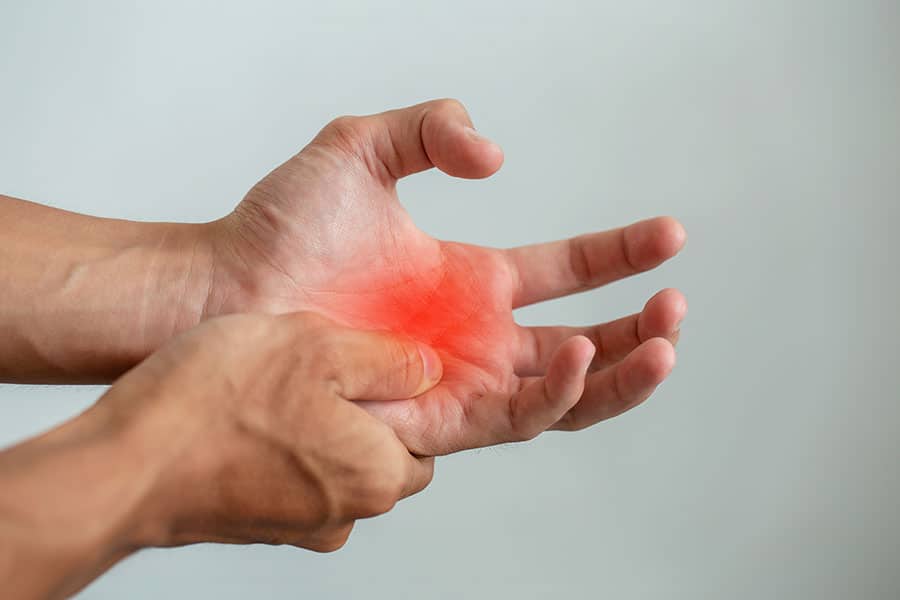
Morning stiffness in a finger that eases once you have been moving for a while. A faint clicking or snapping when bending or straightening the finger. Tenderness or a small, firm nodule at the base of the affected finger, on the palm side of the hand. And the start of finger locking symptoms, meaning the finger catching or briefly sticking before releasing with a snap.
None of these isare dramatic on their own. That is the problem. By the time the finger is locking consistently and causing real pain, the condition is already well-established.
What causes trigger finger?
Trigger finger causes are not always clear-cut, but several factors increase the likelihood:
Repetitive gripping is a common contributor. People whose work or hobbies involve prolonged or forceful hand use, such as tools, instruments, certain sporting equipment, put sustained stress on the tendon sheath over time.
Underlying health conditions also play a role. Trigger finger is significantly more common in patients with diabetes, rheumatoid arthritis, or gout, all of which affect tendon and joint health. It also tends to occur more often in women and in adults between 40 and 60 years of age. Prior trauma to the palm or base of a finger can be a factor as well.
Also Read: 5 Ways Trigger Finger Can Impact Your Life
Trigger finger treatment in Singapore
Trigger finger treatment in Singapore is generally approached in stages, starting with the least invasive option and working up from there depending on how the condition responds. In mild or early cases, a splint worn at night to keep the finger straightened can reduce tendon irritation and allow inflammation to settle. This works best when the condition is caught early.
A corticosteroid injection into the tendon sheath is the next step for cases that do not respond to splinting. It reduces inflammation within the sheath and allows the tendon to move more freely. Many patients get significant relief from one or two injections, though some cases do recur.
When symptoms are severe, persistent, or have not improved with conservative treatment, a trigger finger operation is the recommended course. It is a straightforward procedure performed under local anaesthesia. The surgeon releases the constricted portion of the tendon sheath, freeing the tendon to glide normally again. Trigger finger surgery in Singapore is typically a day procedure, and most patients regain full movement within a few weeks.
When to see a trigger finger specialist in Singapore
If you have noticed any of the early trigger finger signs described above, it is worth getting them assessed before the condition progresses. Waiting until the finger is locking fully or the pain is significant narrows your options.
At Spire Orthopaedic Centre, our hand specialists diagnose and treat trigger finger in Singapore across all stages, from early conservative management through to trigger finger operation where needed. We will assess your condition and recommend treatment suited to where you are in the course of the condition.
Book a consultation today and address your trigger finger before it gets in the way of daily life.
Our Doctors

Dr. Chee Kin Ghee
Dr Chee is a hand surgeon in Singapore with over 20 years of experience in hand and orthopaedic surgery.
He is currently practising at Gleneagles Hospital and was a visiting consultant at Tan Tock Seng Hospital to train the residents towards their specialisation in hand surgery.

Dr. Ambrose Yung
Dr Ambrose Yung Wai Yin is an experienced Specialist Orthopaedic Consultant with 20 years of experience in the field of orthopaedics. His area of interest extends includes complex operations such as revision knee arthroplasty, partial knee replacement and primary total knee replacement.
View More
Dr. Low Mun Hon
Dr Low Mun Hon has over 20 years of experience managing trauma and orthopaedic clinical care.
Prior to this, he has been in private practice as a practitioner at Singapore Sports & Orthopaedic Clinic (SSOC).

Justin Lim Xuan Li Physiotherapist
Justin is a skilled and experienced physiotherapist who specializes in the treatment of neuro-musculoskeletal conditions - nerve, muscle and joint problems.
View More
Chan Jing Cheng (JC) Physiotherapist
JC has over 12 years of experience in treating Chronic pain, Orthopaedic and Geriatric conditions. He had worked at various Private Hospitals, Singapore General Hospital, NTUC Health Elder Care and Lions Home for the Elders.
View More
Joanna Lim Hand Occupational Therapy
Joanna obtained her Diploma in Occupational Therapy (Merit) from Nanyang Polytechnic in 2006. Under the MOH Health Science Scholarship, she graduated from La Trobe University, Australia, with a Bachelor’s degree in Occupational Therapy (1st class Honours) the following year. Upon graduation, she worked in Changi General Hospital and Sengkang General Hospital.
View MoreConsultation
Spire Orthopaedic Physiotherapy & Rehab Centre
Spire Orthopaedic Centre @ Royal Square
101 Irrawaddy Road, #18-03
Royal Square Medical Centre, Novena
Singapore 329565
Tel: (65) 6970 4468
Mobile: (65) 8031 4388
Email: admin@spireortho.com.sg
SPIRE HIP & KNEE CENTRE
Spire Orthopaedic Centre @ Gleneagles Medical Centre
6 Napier Road #08-04
Singapore 258499
Tel: (65) 6970 6628
Mobile: (65) 8317 7388
Email: gmc@spireortho.com.sg
SPIRE HAND CENTRE
Spire Hand Centre @ Mount Elizabeth Medical Centre
3 Mount Elizabeth #15-14
Singapore 228510
Mobile: (65) 9657 2268
Email: meoh@spireortho.com.sg