 80314388

Rotator Cuff Tear vs Frozen Shoulder: How to Tell the Difference
Summary:
- Rotator cuff tear and frozen shoulder both cause shoulder pain and disturbed sleep, but they are distinct conditions that require different treatment.
- The key difference is movement: frozen shoulder restricts passive motion in all directions, while a rotator cuff tear causes pain and weakness but usually preserves passive range.
- Getting the right shoulder injury diagnosis in Singapore early means getting the right treatment, and avoiding months of managing the wrong condition.
Shoulder pain that does not go away is frustrating enough. What makes it worse is not knowing which condition you are dealing with, because a rotator cuff tear and frozen shoulder look similar on the surface, and they are commonly confused.
Both cause significant shoulder pain, both often worsen at night, and both can develop gradually without an obvious injury. But they are different conditions with different mechanisms, different clinical features, and different treatment approaches. Here is how to tell them apart.
What is a rotator cuff tear?
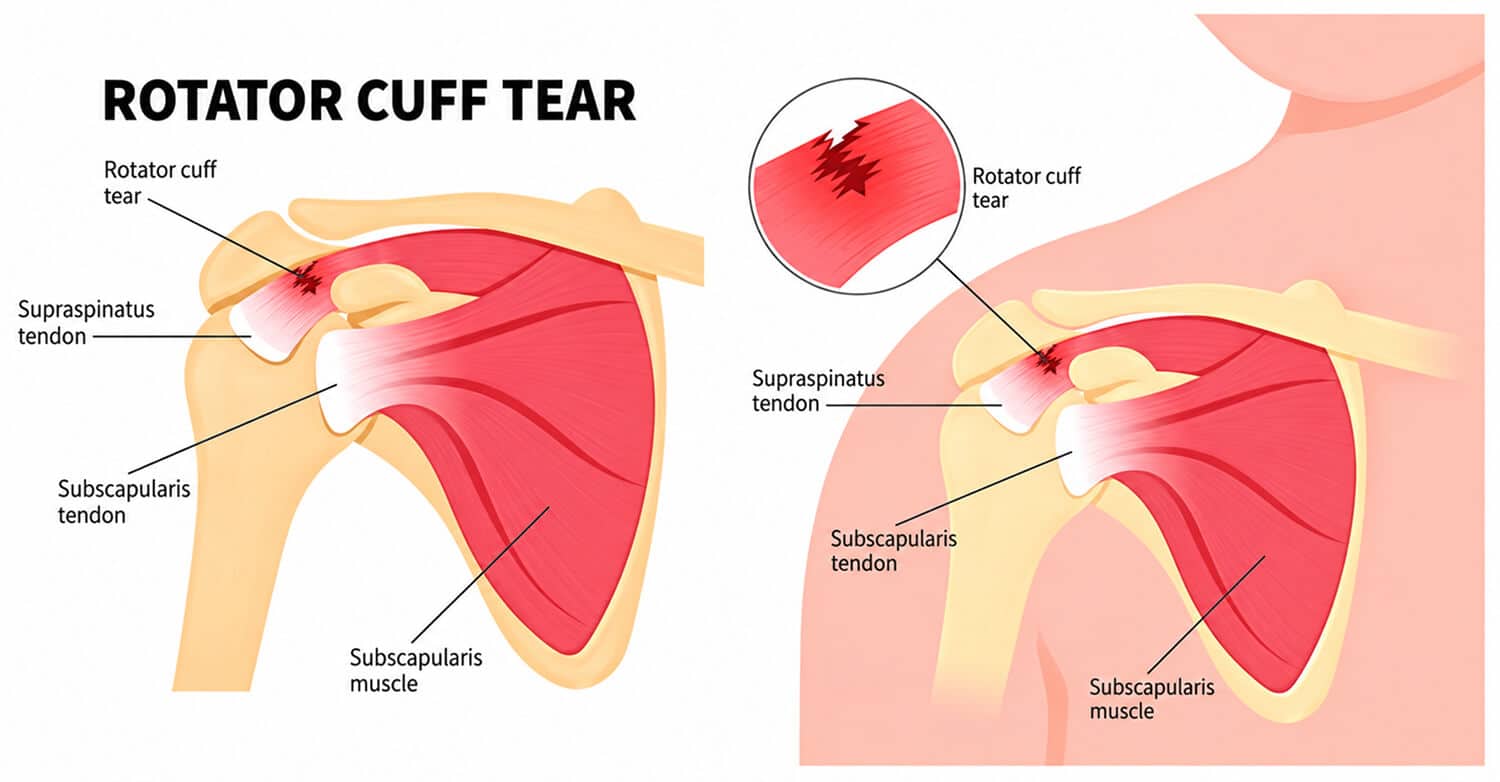
The rotator cuff is a group of four muscles and their tendons that surround the shoulder joint, keeping the upper arm bone seated in the socket and allowing a wide range of movement. A tear occurs when one or more of these tendons are damaged, either from a sudden injury or from gradual wear over time.
Rotator cuff tear symptoms typically include:
- Pain when lifting the arm, reaching overhead, or rotating across the body
- Weakness when lifting, particularly against resistance
- Night pain that disturbs sleep, especially when lying on the affected shoulder
- A clicking or catching sensation during shoulder movement
- Gradual worsening of pain over weeks or months without a specific injury
What is a frozen shoulder?
Frozen shoulder, medically known as adhesive capsulitis, occurs when the capsule surrounding the shoulder joint becomes inflamed and progressively tightens. It typically moves through three stages: a freezing phase where pain increases and movement starts to restrict; a frozen phase where stiffness is at its worst; and a thawing phase where movement gradually returns.
Symptoms include:
- Progressive stiffness in all directions, both painful and restrictive
- Pain that is often worse at night in the early stages
- Difficulty with everyday movements, reaching behind the back, lifting the arm, putting on a coat
- Gradual onset with no specific injury in most cases
The key clinical difference
This is the most reliable way to distinguish the two conditions, and it is what your orthopaedic specialist will assess in examination.
With frozen shoulder, movement is restricted both when you try to move the arm yourself (active range) and when someone else moves it for you (passive range). The joint capsule is physically contracted. The restriction is the defining feature, not just the pain.
With a rotator cuff tear, passive range of motion, someone else moving your arm, is usually preserved. You can still be moved through a reasonable range. What is limited is active, resisted movement because the torn tendon cannot generate normal force. Pain and weakness are the dominant features, not a locked joint.
This distinction matters because it directly changes what you should do next. Treating a rotator cuff tear with frozen shoulder protocols does not work, and vice versa.
How is a shoulder injury diagnosed?
Physical examination is the starting point. Your orthopaedic specialist will test active and passive range of motion, strength against resistance, and where the pain is located and provoked. These findings already give a strong indication of which condition is present.
Imaging confirms the diagnosis:
- MRI scan: The gold standard for visualising the rotator cuff tendons and identifying the size and location of a tear, as well as assessing the joint capsule in frozen shoulder
- Ultrasound: Useful for dynamic assessment of the tendons and detecting partial or full-thickness tears
- X-ray: Rules out bony causes of shoulder pain such as arthritis or a fracture
Rotator cuff injury treatment in Singapore
Treatment depends on what the diagnosis confirms.
For rotator cuff tears, the approach is conservative-first for partial tears, anti-inflammatory medication, corticosteroid injections, and activity modification. Surgical repair is recommended for complete or large tears, for patients who have not responded to conservative management, or for those who need full shoulder function restored. The most common procedure is arthroscopic rotator cuff repair, where the torn tendon is reattached through small incisions.
For frozen shoulders, treatment is tailored to the stage. In the freezing phase, corticosteroid injections can significantly reduce pain and slow the progression of stiffness. In the frozen and thawing phases, structured physiotherapy focuses on restoring range of motion progressively. For cases that do not respond to conservative care, hydrodilatation, injecting fluid into the joint capsule to stretch it, or surgical release under anaesthesia may be considered.
See an orthopaedic shoulder specialist in Singapore
If your shoulder has been painful or stiff for more than a few weeks without improvement, do not keep waiting. The longer a rotator cuff tear is left unmanaged, the larger it can become. And frozen shoulder, if untreated, can progress through all three stages over one to three years.
At Spire Orthopaedic Centre, our orthopaedic specialists carry out thorough shoulder injury diagnosis in Singapore and recommend the most appropriate rotator cuff injury treatment or frozen shoulder management for your specific condition.
Book a consultation today and get a clear answer on what is happening with your shoulder.
Our Doctors

Dr. Chee Kin Ghee
Dr Chee is a hand surgeon in Singapore with over 20 years of experience in hand and orthopaedic surgery.
He is currently practising at Gleneagles Hospital and was a visiting consultant at Tan Tock Seng Hospital to train the residents towards their specialisation in hand surgery.

Dr. Ambrose Yung
Dr Ambrose Yung Wai Yin is an experienced Specialist Orthopaedic Consultant with 20 years of experience in the field of orthopaedics. His area of interest extends includes complex operations such as revision knee arthroplasty, partial knee replacement and primary total knee replacement.
View More
Dr. Low Mun Hon
Dr Low Mun Hon has over 20 years of experience managing trauma and orthopaedic clinical care.
Prior to this, he has been in private practice as a practitioner at Singapore Sports & Orthopaedic Clinic (SSOC).

Justin Lim Xuan Li Physiotherapist
Justin is a skilled and experienced physiotherapist who specializes in the treatment of neuro-musculoskeletal conditions - nerve, muscle and joint problems.
View More
Chan Jing Cheng (JC) Physiotherapist
JC has over 12 years of experience in treating Chronic pain, Orthopaedic and Geriatric conditions. He had worked at various Private Hospitals, Singapore General Hospital, NTUC Health Elder Care and Lions Home for the Elders.
View More
Joanna Lim Hand Occupational Therapy
Joanna obtained her Diploma in Occupational Therapy (Merit) from Nanyang Polytechnic in 2006. Under the MOH Health Science Scholarship, she graduated from La Trobe University, Australia, with a Bachelor’s degree in Occupational Therapy (1st class Honours) the following year. Upon graduation, she worked in Changi General Hospital and Sengkang General Hospital.
View More