 80314388

Meniscus Repair vs Meniscectomy: What Is the Difference and Which Do You Need?
Summary:
- Meniscus repair stitches the torn cartilage back together to heal naturally; meniscectomy removes the damaged portion of the meniscus.
- The right procedure depends on the location, pattern, and severity of the tear, as well as your age and activity level.
- Meniscus repair has better long-term outcomes for knee health when the tear is suitable, but recovery takes significantly longer than partial meniscectomy.
When your orthopaedic specialist recommends surgery for a meniscus tear, there are two fundamentally different approaches, and which one is right for you depends on the nature of your tear, not just patient preference.
Here is what you need to understand about both before your consultation.
What is the meniscus and why does it matter?
The meniscus is a C-shaped piece of cartilage that sits between your thighbone and shinbone. You have two in each knee, one on the inner side (medial) and one on the outer side (lateral). Together they act as shock absorbers, distribute load across the joint, and help stabilise the knee during movement.
When a meniscus tears, you lose some of that protective function. What happens next depends on where the tear is and what it looks like.
Meniscus repair: preserving what you have
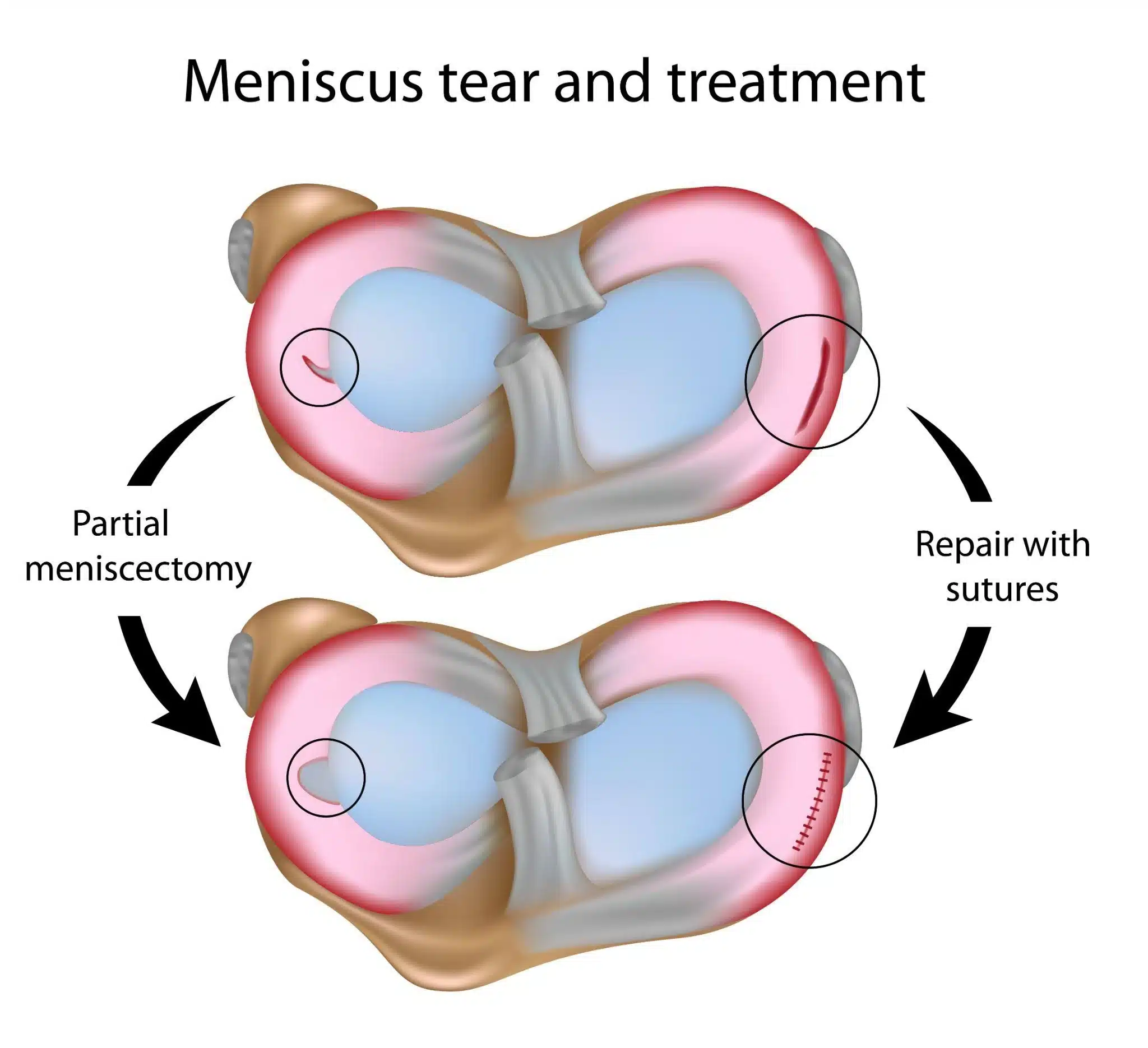
Meniscus repair is exactly what it sounds like. The torn edges of the cartilage are stitched back together so they can heal on their own. The goal is to preserve as much of the natural meniscus as possible.
Not every tear can be repaired. Repairs work best when:
- The tear is in the outer one-third of the meniscus, where blood supply is sufficient to support healing
- The tear is a clean, vertical pattern rather than a degenerative or complex pattern
- The patient is younger, and the tissue is still in good condition
- The tear is relatively recent rather than long-standing
When repair is possible and appropriate, it offers the best long-term outcome for the knee. Studies consistently show lower rates of osteoarthritis development in patients who have a successful repair compared to those who have tissue removed.
The trade-off is recovery time. After meniscus repair, patients typically spend three to six months rehabilitating before returning to sport or high-demand activity. Weight-bearing is restricted in the early weeks to allow the repair to heal without being loaded.
Meniscectomy: removing the damaged tissue
Partial meniscectomy involves removing the torn portion of the meniscus while leaving as much healthy tissue intact as possible. Total meniscectomy, removing the entire meniscus, is now rarely performed, as the long-term consequences for joint health are significant.
Meniscectomy is typically recommended when:
- The tear is in the inner two-thirds of the meniscus, where there is little or no blood supply and healing cannot occur
- The tear is degenerative, complex, or has a pattern that cannot be stitched effectively
- The patient is older and has underlying joint changes that make repair less beneficial
- The tear is causing mechanical symptoms such as locking or giving way that require prompt resolution
Recovery from partial meniscectomy is considerably faster than repair. Most patients return to work in one to three weeks and to sport in four to six weeks. However, removing meniscal tissue permanently reduces the joint’s shock-absorbing capacity, which over time increases the risk of knee osteoarthritis, particularly in younger, more active patients.
This is why your surgeon’s recommendation matters. Choosing meniscectomy when repair was possible is not a neutral decision for the long-term health of the knee.
The long-term picture
For patients who are young, active, and have a repairable tear, meniscus repair is almost always the preferred option despite the longer recovery. The investment in time pays off in better knee preservation over the following decades.
For older patients, those with degenerative tears, or those whose tears are simply not repairable, partial meniscectomy remains a well-established and effective procedure. The priority shifts from preservation to symptom relief and function restoration.
Some tears are borderline;, the decision genuinely depends on what the surgeon finds when they are inside the joint. Your specialist will discuss this with you clearly before surgery and again during the arthroscopy if the picture is different from what imaging showed.
Seek meniscus tear surgery assessment in Singapore
If you have been told you have a meniscus tear and are considering surgery, getting a clear explanation of which procedure is appropriate for your specific tear is important before you proceed.
At Spire Orthopaedic Centre, our specialists assess each meniscus tear thoroughly and walk you through the surgical and non-surgical options. Whether you need a repair, a meniscectomy, or neither yet, we will give you a clear recommendation and the reasoning behind it.
Book a consultation today to get a clear assessment of your meniscus tear.
Our Doctors

Dr. Chee Kin Ghee
Dr Chee is a hand surgeon in Singapore with over 20 years of experience in hand and orthopaedic surgery.
He is currently practising at Gleneagles Hospital and was a visiting consultant at Tan Tock Seng Hospital to train the residents towards their specialisation in hand surgery.

Dr. Ambrose Yung
Dr Ambrose Yung Wai Yin is an experienced Specialist Orthopaedic Consultant with 20 years of experience in the field of orthopaedics. His area of interest extends includes complex operations such as revision knee arthroplasty, partial knee replacement and primary total knee replacement.
View More
Dr. Low Mun Hon
Dr Low Mun Hon has over 20 years of experience managing trauma and orthopaedic clinical care.
Prior to this, he has been in private practice as a practitioner at Singapore Sports & Orthopaedic Clinic (SSOC).

Justin Lim Xuan Li Physiotherapist
Justin is a skilled and experienced physiotherapist who specializes in the treatment of neuro-musculoskeletal conditions - nerve, muscle and joint problems.
View More
Chan Jing Cheng (JC) Physiotherapist
JC has over 12 years of experience in treating Chronic pain, Orthopaedic and Geriatric conditions. He had worked at various Private Hospitals, Singapore General Hospital, NTUC Health Elder Care and Lions Home for the Elders.
View More
Joanna Lim Hand Occupational Therapy
Joanna obtained her Diploma in Occupational Therapy (Merit) from Nanyang Polytechnic in 2006. Under the MOH Health Science Scholarship, she graduated from La Trobe University, Australia, with a Bachelor’s degree in Occupational Therapy (1st class Honours) the following year. Upon graduation, she worked in Changi General Hospital and Sengkang General Hospital.
View More