 80314388

Why Does Shoulder Pain Get Worse at Night?
Summary:
- Shoulder pain at night is one of the telling signs of a rotator cuff tear, though conditions like frozen shoulder can produce similar symptoms.
- Knowing the difference between these two conditions helps you get the right diagnosis and the right rotator cuff injury treatment.
- Torn rotator cuff treatment in Singapore ranges from conservative management to surgical repair, depending on the severity of the tear.
You make it through the day well enough. But the moment you lie down, your shoulder starts aching, and finding a position that does not aggravate it feels impossible.
Shoulder pain that worsens at night is one of the most consistent complaints among patients with rotator cuff injuries. It is also, frustratingly, one of the symptoms people tend to put up with the longest before seeking help. Here is why it happens, what it might mean, and what can be done about it.
Why shoulder pain gets worse at night
During the day, the muscles around your shoulder are active and doing their share of the work. When you lie down, that changes.
Without muscle tone to support the joint, more load falls onto already-irritated tendons. If you sleep on the affected shoulder, the added compression makes things worse. There is also a circulatory shift when you are horizontal that can intensify inflammation in damaged tissue. And without the distractions of a busy day, your brain gives the pain signal far more attention.
All of this is why patients with rotator cuff injuries often describe night as the worst part of their day.
Also Read: Is Your Shoulder Pain a Torn Rotator Cuff?
Rotator cuff tear symptoms to watch for
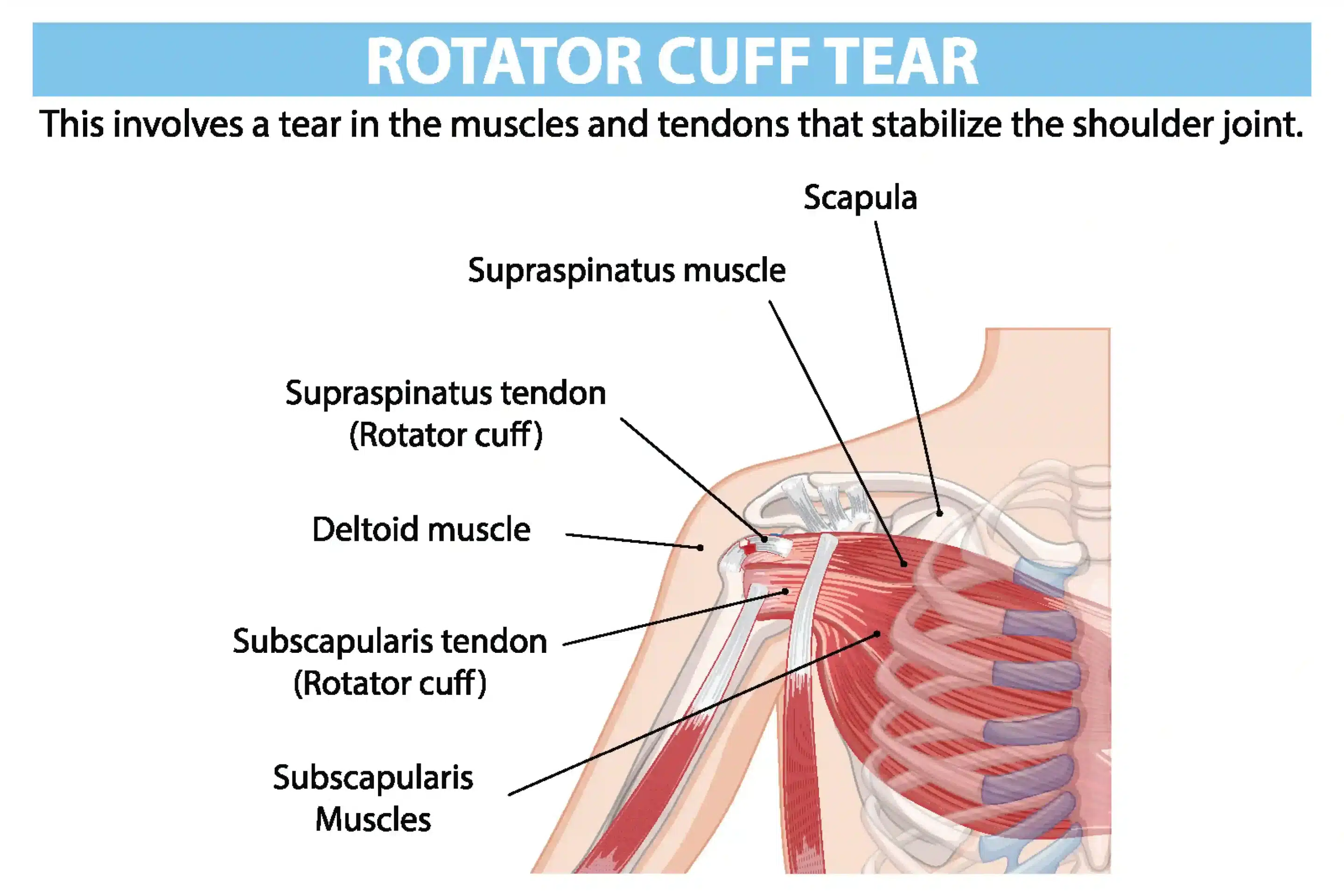
The rotator cuff is a group of four muscles and their tendons that keep the upper arm bone seated in the shoulder socket. A tear, whether partial or complete, disrupts that structure.
Common rotator cuff tear symptoms include:
- Shoulder pain at night that is bad enough to wake you or prevent sleep
- Pain when reaching overhead, behind your back, or across your body
- Weakness when lifting or rotating the arm
- A clicking or catching sensation during shoulder movement
- Pain that worsens gradually over weeks rather than improving
Tears can come from a single injury such as a fall or a heavy lift or from years of repetitive overhead activity that slowly wears the tendon down.
Also Read: FAQs About Torn Rotator Cuff
Frozen shoulder vs rotator cuff: what is the difference?
Both conditions cause shoulder pain that tends to worsen at night, which is why they are often confused. But the clinical picture is quite different.
Frozen shoulder (adhesive capsulitis) involves progressive stiffening of the shoulder joint capsule. The defining feature is restricted movement in all directions, both when you try to move the arm yourself and when someone else moves it for you. Patients typically cannot lift the arm to the side or rotate it regardless of effort. The restriction, not just the pain, is the tell.
Rotator cuff tear, by contrast, does not usually lock the joint in the same way. Range of motion may be partially preserved. You can often still raise the arm with some effort. What stands out is pain and weakness, particularly when moving against resistance, and night pain that is hard to sleep through.
If you are unsure which condition you have, imaging is the most reliable way to get a clear answer.
How is a rotator cuff injury diagnosed?
Your orthopaedic specialist will assess the shoulder through a physical examination, testing strength, range of motion, and where the pain is localised. Imaging is used to confirm the diagnosis:
- An MRI provides a detailed view of the rotator cuff tendons and identifies the size and location of any tear.
- Ultrasound can detect partial or full-thickness tears and is useful for dynamic assessment.
- An X-ray rules out bony abnormalities or arthritis that may be contributing to symptoms.
Rotator cuff injury treatment in Singapore
Rotator cuff injury treatment in Singapore depends on the type and size of the tear, your age, your activity level, and how much the pain is affecting daily life and sleep.
For partial tears or patients with lower activity demands, conservative management is often the starting point. This typically involves anti-inflammatory medication, corticosteroid injections into the shoulder joint for targeted relief, and activity modification to reduce aggravation.
Torn rotator cuff treatment through surgery is generally recommended when the tear is large or complete, when conservative measures have not provided sufficient relief, or when the patient needs full shoulder function restored. The most common procedure is arthroscopic rotator cuff repair, where the torn tendon is reattached to bone through small incisions. Where the tear is irreparable, your orthopaedic surgeon may discuss alternative options such as tendon transfer or shoulder replacement.
When to see an orthopaedic specialist in Singapore
Shoulder pain at night that consistently disrupts sleep, or shoulder weakness that is limiting everyday activity, warrants an orthopaedic assessment sooner rather than later. Rotator cuff tears do not tend to improve on their own, and larger tears are more complex to treat.
At Spire Orthopaedic Centre, our specialists will assess your shoulder thoroughly, confirm the diagnosis, and recommend the most appropriate rotator cuff injury treatment for your situation. For patients who require surgery, our team handles arthroscopic shoulder procedures with the goal of restoring function and lasting shoulder pain relief.
Book a consultation today and get to the root of your shoulder pain.
Our Doctors

Dr. Chee Kin Ghee
Dr Chee is a hand surgeon in Singapore with over 20 years of experience in hand and orthopaedic surgery.
He is currently practising at Gleneagles Hospital and was a visiting consultant at Tan Tock Seng Hospital to train the residents towards their specialisation in hand surgery.

Dr. Ambrose Yung
Dr Ambrose Yung Wai Yin is an experienced Specialist Orthopaedic Consultant with 20 years of experience in the field of orthopaedics. His area of interest extends includes complex operations such as revision knee arthroplasty, partial knee replacement and primary total knee replacement.
View More
Dr. Low Mun Hon
Dr Low Mun Hon has over 20 years of experience managing trauma and orthopaedic clinical care.
Prior to this, he has been in private practice as a practitioner at Singapore Sports & Orthopaedic Clinic (SSOC).

Justin Lim Xuan Li Physiotherapist
Justin is a skilled and experienced physiotherapist who specializes in the treatment of neuro-musculoskeletal conditions - nerve, muscle and joint problems.
View More
Chan Jing Cheng (JC) Physiotherapist
JC has over 12 years of experience in treating Chronic pain, Orthopaedic and Geriatric conditions. He had worked at various Private Hospitals, Singapore General Hospital, NTUC Health Elder Care and Lions Home for the Elders.
View More
Joanna Lim Hand Occupational Therapy
Joanna obtained her Diploma in Occupational Therapy (Merit) from Nanyang Polytechnic in 2006. Under the MOH Health Science Scholarship, she graduated from La Trobe University, Australia, with a Bachelor’s degree in Occupational Therapy (1st class Honours) the following year. Upon graduation, she worked in Changi General Hospital and Sengkang General Hospital.
View More